Improving your website’s visibility on Google requires more than publishing quality content or adding keywords to your pages. A successful SEO strategy also depends on how well search engines can crawl, index and understand your website.
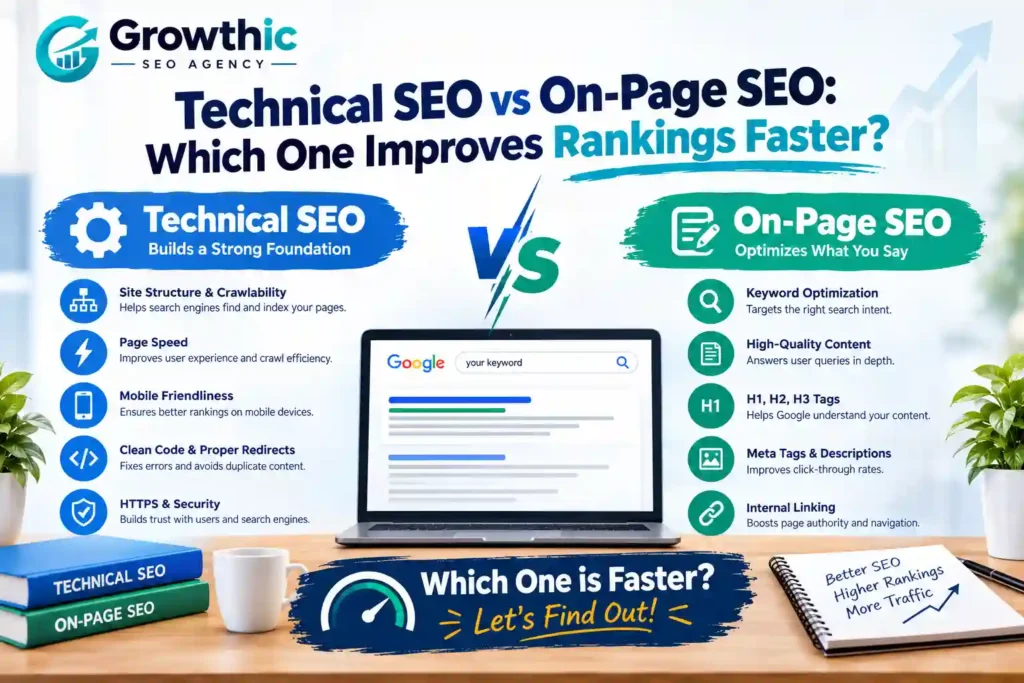
Two essential parts of this process are technical SEO and on-page SEO. While technical SEO focuses on website performance and infrastructure, on-page SEO concentrates on content quality, keyword relevance and page optimisation.
But which one improves rankings faster? The answer depends on your website’s current condition, existing SEO issues and target keywords.
In this guide, we’ll explore the differences between technical SEO and on-page SEO, when each can make a difference, and how to combine them to improve your website’s organic visibility.
What Is Technical SEO?
Technical SEO is the process of improving a website’s infrastructure so search engines can discover, crawl, render and index its important pages efficiently.
It focuses on the technical aspects of a website rather than the content visitors read. A technically accessible website helps search engines understand its structure and find relevant pages.
Important elements of technical SEO include:
- Website speed: Improving loading performance to provide a smoother browsing experience.
- Mobile-friendliness: Ensuring that pages work properly on smartphones and tablets.
- Crawlability: Helping search engine bots access important website pages.
- Indexability: Ensuring that eligible pages can be included in search results.
- XML sitemap: Helping search engines discover important URLs.
- Robots.txt: Managing which parts of a website crawlers are permitted to access.
- HTTPS: Securing connections between the website and its visitors.
- Structured data: Providing additional information about page content in a machine-readable format.
For example, if an important service page has an accidental noindex directive, resolving it may allow Google to consider that page for indexing. However, indexing and ranking are not guaranteed.
What Is On-Page SEO?
On-page SEO involves optimising individual website pages to make their content more relevant, useful and accessible to visitors and search engines.
It helps search engines understand the subject of a page and how well its content addresses a user’s search intent.
Important elements of on-page SEO include:
- Keyword research: Identifying relevant search terms and understanding user intent.
- Title tags: Writing unique, descriptive titles for individual pages.
- Meta descriptions: Summarising page content to help users understand search results.
- Heading structure: Organising content with clear H1, H2 and H3 headings.
- Content quality: Publishing original, useful and accurate information.
- Internal linking: Connecting related pages to improve navigation and content discovery.
- Image optimisation: Using descriptive filenames, suitable formats and meaningful alt text.
- URL structure: Creating clear and descriptive URLs.
For example, if a page about technical SEO targets a broad keyword but mainly discusses website speed, improving its content to cover the topic more accurately may help it better satisfy the intended search query.
Technical SEO vs On-Page SEO: Key Differences
Both approaches contribute to SEO, but they address different aspects of website optimisation.
| Factor | Technical SEO | On-Page SEO |
| Primary focus | Website infrastructure | Content and page relevance |
| Main objective | Improve crawling and indexing | Match content with search intent |
| Main activities | Speed, indexing, sitemaps and site structure | Keywords, headings, content and internal links |
| Main beneficiaries | Search engines and website visitors | Website visitors and search engines |
| Typical tools | Search Console, Screaming Frog, PageSpeed Insights | Rank Math, Yoast SEO, Semrush |
| Common issues | Crawl errors, blocked pages and redirects | Poor content, unclear headings and weak keyword targeting |
| Ranking impact | Helps remove technical barriers | Helps improve relevance and usefulness |
| Long-term role | Supports website accessibility and performance | Supports content relevance and user satisfaction |
Neither approach replaces the other. Technical SEO helps make content accessible, while on-page SEO helps make that content relevant.
Which Improves Rankings Faster: Technical SEO or On-Page SEO?
There is no universal answer. The speed and extent of improvement depend on the problems affecting your website.
<box border={{size:1,color:”#16a34a”}} background=”surface” radius=”lg” padding={3} gap={1}>
Technical SEO may have a quicker impact when serious crawling, indexing or rendering problems prevent important pages from appearing in search results.
On-page SEO may have a quicker impact when your website is technically healthy but its content does not adequately match the searches you want to target.
For example, fixing an accidental indexing block on an important page may make it eligible to appear in search results. Similarly, improving an existing article that does not adequately address its target search intent may improve its relevance.
However, neither change guarantees an immediate ranking improvement. Search engines need to recrawl and reassess pages, and rankings also depend on competition and other factors.
When Does Technical SEO Make More Sense?
Technical SEO should receive early attention when important pages have accessibility or indexing problems.
Consider prioritising it in the following situations:
1. Important pages are not indexed
Use Google Search Console to investigate whether important URLs are excluded from indexing. Check for accidental noindex directives, incorrect canonical tags and crawl restrictions.
2. Your website has serious performance issues
Slow loading, delayed interactions and unexpected layout shifts can negatively affect user experience. Review Core Web Vitals and prioritise problems affecting important pages.
3. Your website has broken internal links
Broken links and unnecessary redirect chains can make navigation difficult and complicate crawling. Identify and correct links that lead to outdated or unavailable URLs.
4. Your website has a complicated structure
Large websites, especially e-commerce platforms, may have duplicate URLs, deep navigation structures and unnecessary pages. Improving site architecture can make important content easier to discover.
When Does On-Page SEO Make More Sense?
On-page SEO deserves attention when your website is technically accessible but its pages are not meeting users’ needs.
1. Your content does not match search intent
A user searching for a comparison expects a different page from someone looking for a definition. Review the search intent behind your target keywords and make sure your content addresses it.
2. Your existing content is outdated
Review articles and service pages regularly. Update inaccurate information, add relevant details and remove sections that no longer provide value.
3. Your pages have weak titles and headings
Use descriptive titles and headings that accurately represent the page. Avoid repeating keywords unnaturally or creating headings solely for search engines.
4. Your website has poor internal linking
Link relevant pages together using descriptive anchor text. For example, an article about website speed can link to a related technical SEO service page when it genuinely helps readers.
How Technical SEO and On-Page SEO Work Together
A successful SEO strategy combines both approaches instead of treating them as competing activities.
Consider a website that publishes an article about local SEO services.
First, technical SEO ensures that the article can be crawled and indexed, uses a valid canonical URL and works properly on mobile devices.
Next, on-page SEO ensures that the article has a clear title, useful headings, accurate information, relevant internal links and content that addresses the reader’s needs.
If the technical foundation is weak, useful content may not receive its full search visibility. If the content is weak, a technically perfect website may still struggle to satisfy search queries.
Combining both approaches helps address these different problems.
Best Practices for Technical SEO in 2026
Technical SEO should focus on accessibility, performance and a clear website structure.
- Monitor Core Web Vitals: Review loading performance, responsiveness and visual stability.
- Prioritise mobile usability: Make sure important pages are easy to navigate on mobile devices.
- Check indexing regularly: Use Google Search Console to identify unexpected indexing exclusions.
- Maintain a clean sitemap: Include important, canonical and indexable URLs.
- Review internal links: Fix broken links and improve navigation to important pages.
- Use structured data appropriately: Add relevant, valid structured data where it accurately describes page content.
- Maintain HTTPS: Ensure that important pages use secure connections.
- Review technical changes: Check redirects, canonical tags and indexing after website redesigns or migrations.
Regular monitoring can help identify issues before they affect a large number of pages.
Best Practices for On-Page SEO in 2026
On-page SEO should prioritise helpful content, clear organisation and relevance.
- Understand search intent: Identify what users expect to find before writing or updating a page.
- Use keywords naturally: Include relevant terms where they make sense without keyword stuffing.
- Write descriptive titles: Make each page’s title accurate and distinct.
- Improve content quality: Provide useful explanations, original examples and reliable information.
- Organise headings: Use a logical heading hierarchy to make content easier to follow.
- Strengthen internal linking: Connect related articles, services and resources.
- Optimise images: Use appropriate image formats and descriptive alt text when images convey meaningful information.
- Review existing pages: Update content when facts, services or user requirements change.
Focus on satisfying visitors rather than increasing keyword frequency.
Tools for Technical SEO and On-Page SEO
The right SEO tools can help you identify problems and monitor improvements.
| Tool | Primary use |
| Google Search Console | Search performance, indexing and technical reports |
| Google PageSpeed Insights | Page performance and Core Web Vitals |
| Screaming Frog | Website crawling, broken links and metadata audits |
| Google Analytics 4 | Website traffic and user interactions |
| Semrush | Keyword research, competitor analysis and site audits |
| Ahrefs | Keyword research, backlinks and content analysis |
| Rank Math | On-page optimisation in WordPress |
| Yoast SEO | Metadata and content optimisation in WordPress |
You do not need every tool. Start with Google Search Console and PageSpeed Insights, then add specialist tools according to your website’s needs.
Common SEO Mistakes to Avoid
Even a well-planned SEO strategy can be less effective when important issues are overlooked.
- Focusing only on keywords: Content should address search intent, not simply include target phrases.
- Ignoring technical problems: Important pages may remain inaccessible or unindexed.
- Making unnecessary changes: Changing titles and URLs without a clear reason can introduce new problems.
- Publishing repetitive content: Multiple pages targeting the same intent can create unnecessary competition within your own website.
- Expecting immediate results: SEO improvements may take time to be reflected in search results.
- Ignoring performance data: Review actual search and website data rather than relying entirely on assumptions.
Prioritise improvements according to their likely impact, implementation effort and relevance to your business objectives.
Frequently Asked Questions
1. What is the main difference between technical SEO and on-page SEO?
Technical SEO focuses on a website’s infrastructure, including crawling, indexing and performance. On-page SEO focuses on content, headings, metadata, keywords and internal links. Both help search engines discover and understand relevant website pages.
2. Which is more important, technical SEO or on-page SEO?
Both are important, but their relative priority depends on the website. Serious technical issues may need attention before content optimisation, while a technically healthy website may benefit more from improving its content and search intent alignment.
3. Does technical SEO improve Google rankings faster?
It can make a difference when technical problems prevent important pages from being crawled or indexed. However, resolving an issue does not guarantee a ranking increase, and the time required for Google to reassess a page varies.
4. Can on-page SEO work without technical SEO?
On-page optimisation can improve content relevance even without extensive technical work. However, important pages still need to be accessible and eligible for indexing. Serious technical problems can limit the visibility of otherwise useful content.
5. How often should I perform a technical SEO audit?
Audit frequency depends on website size, complexity and how often the website changes. Small websites may benefit from periodic audits, while large or frequently updated websites may need more regular monitoring.
6. Which tools are useful for technical and on-page SEO?
Google Search Console, PageSpeed Insights and Screaming Frog are useful for technical SEO. Semrush, Ahrefs, Rank Math and Yoast SEO can support keyword research and on-page optimisation. Choose tools based on your requirements and budget.
7. Can small businesses benefit from both types of SEO?
Yes. Small businesses can start with basic technical checks, clear service pages, relevant keywords and useful content. Improving these fundamentals can help build a strong foundation for their organic search strategy.
Conclusion
Technical SEO and on-page SEO serve different purposes, but both contribute to a website’s organic search performance. Technical SEO helps search engines access and process your pages, while on-page SEO improves the relevance and usefulness of your content.
Technical improvements may have a quicker impact when serious accessibility or indexing issues exist. On-page improvements may be more useful when your website already has a sound technical foundation but its content needs attention.
Rather than choosing one approach exclusively, review your website’s current condition, identify its most significant issues and prioritise improvements accordingly. A balanced SEO strategy, supported by regular monitoring and useful content, can help your website build sustainable organic visibility over time.