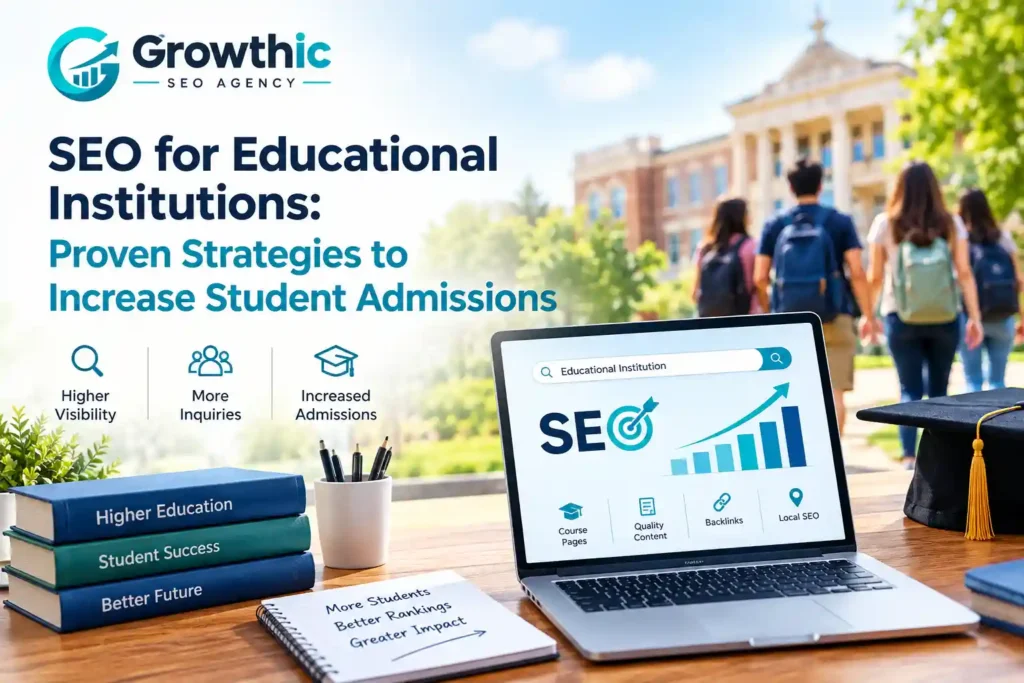
Choosing the right school, college, university or coaching institute often starts with a Google search. Students and parents search online to compare courses, check fees, explore campus facilities and understand admission requirements. If your institution does not appear in relevant search results, you may miss opportunities to connect with prospective students.
SEO for educational institutions helps schools, colleges, universities and coaching centres improve their online visibility, attract relevant visitors and generate admission inquiries. Unlike paid advertising, SEO focuses on building organic visibility that can continue to deliver traffic over time.
In this guide, we’ll explore practical SEO strategies educational institutions can use to improve search visibility, reach prospective students and support their admission goals.
1. Understand Your Audience and Search Intent
An effective SEO strategy starts with understanding what prospective students and parents are searching for. Different users have different needs depending on their stage of the admission journey.
There are three common types of search intent:
- Informational: Users looking for information, such as the eligibility criteria for an MBA or the benefits of studying science.
- Navigational: Users searching for a specific institution, such as its official website or admission portal.
- Transactional: Users ready to take action, such as applying for admission, booking a campus visit or downloading an application form.
Create website content that addresses these different needs. For example, a university can publish course guides for informational searches and dedicated admission pages for students ready to apply.
Understanding search intent helps you create relevant content rather than relying on keywords alone.
2. Conduct Keyword Research for Educational SEO
Keyword research helps educational institutions understand how prospective students search for courses, programs and admission information.
Focus on a combination of primary, secondary and long-tail keywords.
Examples of educational keywords:
- Best MBA colleges in India
- Engineering colleges in Nashik
- Online admission for BBA
- Best coaching classes for competitive exams
- BSc admission eligibility and fees
Long-tail keywords are particularly useful because they often reflect specific questions or requirements. For example, someone searching for “BCA colleges with affordable fees in Pune” has a more specific requirement than someone searching for “BCA colleges.”
You can use tools such as Google Keyword Planner, Google Trends, Semrush, Ahrefs and Ubersuggest to research keyword ideas, search demand and competitors.
Select keywords that match your institution’s actual courses, locations and admission offerings. Avoid targeting unrelated high-volume keywords that are unlikely to attract suitable students.
3. Optimize Your Website’s On-Page SEO
On-page SEO helps search engines understand your website and helps visitors find relevant information.
Start by optimizing the most important pages, including your homepage, course pages, admission pages and contact page.
Important on-page SEO elements include:
- Meta titles: Write unique, descriptive titles that naturally include the primary keyword.
- Meta descriptions: Summarize the page and explain what visitors can expect.
- Headings: Use a clear H1 heading and logical H2 and H3 subheadings.
- URLs: Create short, descriptive URLs that reflect the page topic.
- Images: Compress images and add meaningful alt text where appropriate.
- Internal links: Connect related course pages, admission information, blogs and other useful resources.
For example, a page about BBA admissions should clearly explain eligibility, fees, important dates, course duration and the application process.
Well-organized pages make it easier for students to find information and for search engines to understand your content.
4. Improve Website Speed and Technical SEO
Technical SEO ensures that search engines can access, crawl and index your website properly. It also helps create a smooth experience for prospective students.
Focus on the following areas:
- Mobile responsiveness: Make sure your website works properly on smartphones and tablets.
- Page speed: Optimize images, reduce unnecessary scripts and improve loading performance.
- HTTPS security: Use a secure HTTPS connection throughout your website.
- XML sitemap: Submit an accurate XML sitemap through Google Search Console.
- Robots.txt: Ensure that important pages are not unintentionally blocked.
- Indexing: Regularly check Google Search Console for crawling, indexing and other technical issues.
Educational websites often contain numerous course and department pages. A clear website structure and functional navigation help users and search engines discover important information.
You can use Google Search Console and tools such as Screaming Frog to identify technical problems and monitor website health.
5. Strengthen Local SEO for Educational Institutions
Local SEO is particularly useful for schools, colleges and coaching institutes that attract students from specific cities or surrounding areas.
For example, a coaching centre in Nashik may want to reach students searching for competitive exam classes in Nashik rather than a general audience across India.
To improve local visibility:
- Create and optimize your Google Business Profile.
- Maintain accurate contact information, address and opening hours.
- Choose relevant business categories.
- Add genuine photographs of your campus, classrooms and facilities.
- Encourage students and parents to leave honest reviews.
- Create useful location-specific website content.
- Keep your institution’s name, address and phone number consistent across relevant directories.
Local SEO can help prospective students discover your institution through location-based searches and Google Maps.
However, local visibility depends on several factors, including relevance, distance and prominence. Consistent optimization does not guarantee a particular ranking.
6. Publish Helpful and Relevant Educational Content
Content marketing allows educational institutions to answer common questions and demonstrate their expertise.
Instead of publishing articles only to include keywords, focus on topics that help students and parents make informed decisions.
Consider creating content such as:
- Course selection guides
- Admission procedures and eligibility requirements
- Career opportunities after graduation
- Scholarship information
- Exam preparation tips
- Campus facilities and student life
- Frequently asked questions about admissions
You can also publish student success stories and testimonials with appropriate permission. These can provide useful insights into the student experience.
Keep course and admission information accurate and up to date. Clearly mention relevant academic years, deadlines and eligibility requirements.
Useful content can attract organic traffic, build trust and help prospective students move from research to admission inquiries.
7. Build Quality Backlinks and Online Authority
Backlinks are links from other websites to your website. Relevant, trustworthy backlinks can help search engines understand your website’s reputation and authority.
Educational institutions can explore several legitimate ways to earn backlinks:
- Publish original educational research and useful resources.
- Collaborate with relevant educational organizations.
- Contribute informative articles to reputable education websites.
- Participate in academic events and industry initiatives.
- Share meaningful institutional news with relevant media outlets.
- Maintain accurate listings on relevant educational directories.
Prioritize relevance and editorial quality over the number of backlinks. Avoid buying large quantities of links or participating in automated link-building schemes.
A smaller number of relevant, credible links is more useful than a large collection of low-quality links.
8. Optimize for Mobile, Voice Search and AI Search
Students increasingly use mobile devices to research institutions, explore courses and check admission details. A mobile-friendly website is therefore an important part of an educational SEO strategy.
Make sure important information, such as course fees, eligibility, contact details and admission links, is easy to find on smaller screens.
Voice searches often use conversational questions, such as “Which colleges offer BBA courses in Nashik?” You can address these queries by including clear questions and concise, accurate answers in relevant content.
AI-powered search experiences also make clear, well-structured information valuable. Use descriptive headings, straightforward language, factual explanations and relevant internal links.
There is no guaranteed method to secure placement in AI-generated answers. Focus on publishing reliable, original and helpful information that serves your audience.
9. Monitor SEO Performance and Improve Your Strategy
SEO requires regular monitoring and ongoing improvements. Educational institutions should track performance to understand which pages attract visitors and generate inquiries.
Use Google Analytics 4 to monitor website traffic, engagement and important actions, such as admission form submissions.
Google Search Console can help you track:
- Organic clicks and impressions
- Search queries
- Average search positions
- Page indexing issues
- Mobile usability and search performance information
Review performance regularly and identify pages that need improvements. For example, a course page with substantial organic traffic but few inquiries may need clearer admission information or a more visible application form.
Measure meaningful results rather than focusing exclusively on keyword rankings.
Frequently Asked Questions
1. Why is SEO important for educational institutions?
SEO helps educational institutions improve their visibility in search engines, attract relevant organic traffic and provide useful information to prospective students. It can support admission inquiries and strengthen an institution’s online presence over time.
2. How long does educational SEO take to show results?
SEO timelines vary depending on website condition, competition, content quality and the scope of optimization. Some improvements may become visible within a few months, while meaningful growth in organic traffic can take longer. SEO does not guarantee rankings or admissions.
3. Which keywords should colleges target?
Colleges should target keywords related to their actual courses, locations, eligibility criteria, fees and admission processes. Combining broad course keywords with specific long-tail queries helps address different student requirements.
4. Is local SEO useful for schools and coaching institutes?
Yes. Local SEO can help institutions reach people searching for educational services in specific locations. An accurate Google Business Profile, useful local pages and genuine reviews can support local visibility.
5. Can SEO increase student admissions?
SEO can help attract relevant visitors and generate admission inquiries. However, actual admissions also depend on factors such as course offerings, fees, reputation, student experience and the effectiveness of the admission process.
Conclusion
SEO for educational institutions involves much more than adding keywords to website pages. It requires understanding student search behaviour, creating useful content, improving technical performance, strengthening local visibility and monitoring results.
Schools, colleges, universities and coaching institutes can use these strategies to make their websites easier to discover and more useful for prospective students and parents.
A consistent, user-focused SEO strategy can support long-term organic visibility and help educational institutions build meaningful connections with students throughout the admission journey.