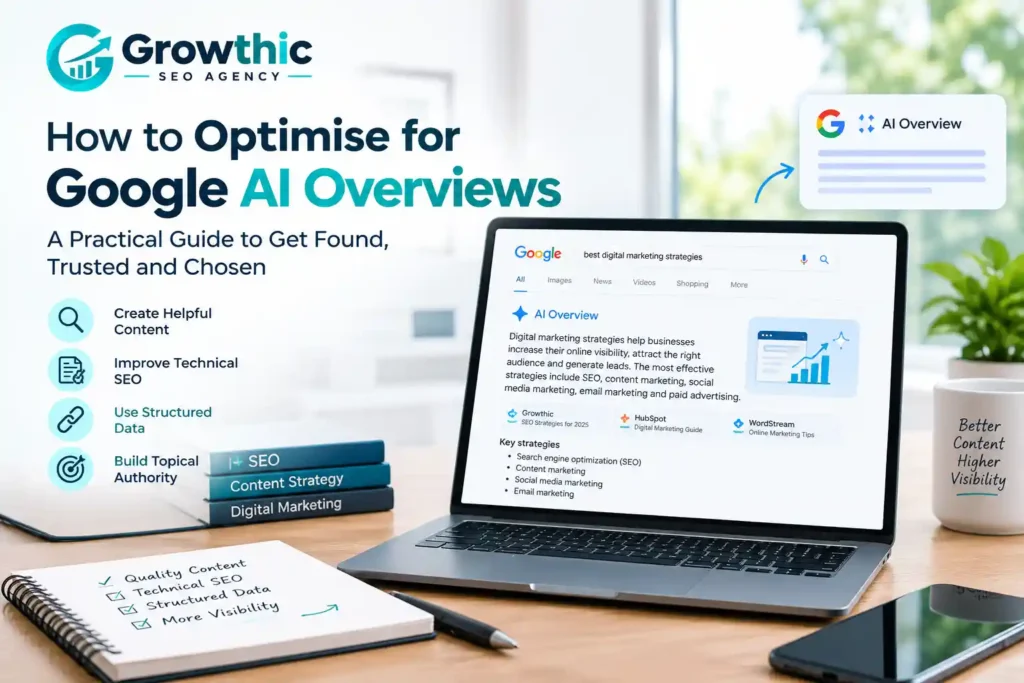
Google Search is evolving, and people are increasingly using AI-generated summaries to understand topics, compare options, and find answers to their questions. For businesses, this creates new opportunities to make useful website content visible in search results.
Optimising for Google AI Overviews means improving your website’s content, structure, and overall SEO so that search engines can understand your pages and potentially use them as sources in AI-generated search experiences.
However, there is no guaranteed method to appear in AI Overviews. Google explains that traditional SEO best practices remain important, and websites still need to meet its technical requirements to be eligible for these features. Google Search Central
In this guide, we will explore practical ways to prepare your website for AI-powered search while keeping your content useful for real people.
What Are Google AI Overviews?
Google AI Overviews are AI-generated summaries that can appear in Google Search for certain queries. They help users understand a topic by bringing together relevant information and providing links to supporting websites.
For example, someone searching for “how to improve a small business website’s SEO” might see an AI-generated overview explaining keyword research, technical SEO, content quality, and website performance.
A website with useful information about these topics may be considered as a supporting source. However, appearing in an AI Overview depends on Google’s systems and is not guaranteed, even when a page follows SEO best practices.
Why Is AI Overview SEO Important?
AI-powered search creates another way for people to discover information online. Businesses should therefore consider how their content serves users who want quick answers as well as those who need detailed explanations.
Potential benefits include:
- Additional search visibility: Your content may be linked as a source within an AI-generated response.
- Improved content quality: Answering genuine customer questions can make your website more helpful.
- Better topic coverage: Well-organized content can explain a subject and its related questions in one useful resource.
- More opportunities to demonstrate expertise: Original insights, practical examples, and reliable information can help differentiate your website.
- Support for customer decisions: Detailed guides can help users understand a product or service before visiting your website.
These benefits are possibilities rather than guaranteed outcomes. AI Overview visibility and website traffic can vary by query, industry, and search behaviour.
1. Create Helpful, Original Content
The foundation of AI Overview optimisation is content that offers real value rather than simply repeating information already available across the internet.
Before writing an article, consider what the reader wants to learn and what information would genuinely help them. Add practical examples, clear explanations, original observations, and relevant details that distinguish your content from competing pages.
For example, an article about SEO pricing in India could explain the factors affecting cost, differences between service packages, common deliverables, and how businesses can evaluate an SEO proposal.
Avoid publishing multiple articles that repeat the same information with slightly different keywords. A smaller collection of useful, well-maintained pages can serve readers better than a large collection of repetitive content.
2. Answer Search Questions Clearly
People often search using direct questions, such as “What is technical SEO?” or “How can I improve my website speed?”
Structure your content so readers can find answers easily.
A practical format is:
- Introduce the topic in a few sentences.
- Answer the main question directly.
- Explain the reasoning or process.
- Include examples, exceptions, or helpful next steps.
For instance, if the heading is “What Is Technical SEO?”, begin by defining technical SEO before discussing crawling, indexing, page speed, and website structure.
Clear answers improve usability and make your content easier to navigate. You do not need to write unnaturally short paragraphs or follow a special format solely to appeal to AI systems.
3. Use Descriptive Headings and Logical Structure
A well-organized article helps readers understand the relationship between different parts of a topic.
Use one clear H1 for the main page heading, H2 headings for major sections, and H3 headings for relevant subsections. Keep each heading descriptive and ensure the content beneath it fulfils the promise of that heading.
For example, an article about ecommerce SEO might include sections on product page optimization, category page SEO, technical improvements, and keyword research.
Use relevant keywords naturally, but do not force the same phrase into every heading. Google can understand related terms and the meaning of a page without requiring every possible keyword variation.
4. Demonstrate Experience and Expertise
Readers need to know whether the information they are reading is accurate and trustworthy, particularly for financial, legal, medical, and other important topics.
Make your content more credible by:
- Identifying the author where appropriate.
- Supporting factual claims with reliable sources.
- Including genuine examples and practical experience.
- Reviewing articles when information changes.
- Correcting inaccurate or outdated statements.
- Clearly distinguishing facts, opinions, and recommendations.
For a business website, publish useful case studies or project examples only when the information is genuine and you have permission to share it.
Avoid fabricated testimonials, invented statistics, and unsupported claims. Trust should come from the quality of the information, not from promotional language.
5. Strengthen Your Traditional SEO Foundations
AI Overview visibility is connected to Google’s broader search systems. Your website should therefore follow sound technical and on-page SEO practices.
Important checks include:
Crawling and indexing: Make sure important pages can be accessed by search engines and are not accidentally blocked through robots.txt, noindex directives, or other technical restrictions.
Internal linking: Link related articles and service pages together so users can discover relevant information and search engines can find important URLs.
Page titles and meta descriptions: Write accurate titles and descriptions that explain what each page offers.
Mobile usability: Ensure your website works well on mobile devices, with readable text and straightforward navigation.
Page performance: Review loading speed and Core Web Vitals, and fix issues that affect the experience of visitors.
Accessible content: Make important information available as readable text rather than placing essential explanations only inside images.
These practices support general search visibility and help users access your content. They do not guarantee inclusion in an AI Overview.
6. Use Relevant Images, Videos, and Structured Data
Text is not the only way to explain a topic. Original diagrams, screenshots, demonstrations, and videos can make complex information easier to understand.
Use descriptive image filenames and meaningful alt text where appropriate. Add captions or transcripts when they help users understand video content.
Structured data can also help search engines interpret certain types of information. Choose schema types that accurately describe the content visible on the page, and follow the relevant guidelines.
There is no special schema markup required specifically for Google AI Overviews. Do not add structured data that misrepresents your page or assume that implementing schema will automatically increase AI visibility.
7. Build Topic Depth Without Repeating Content
A strong content strategy covers the important aspects of a subject in a way that reflects users’ needs.
For example, a website about digital marketing might publish useful guides on keyword research, technical SEO, local SEO, content optimization, and measuring organic performance.
Link related articles together where doing so helps readers explore the subject further. Each page should have a distinct purpose and offer information worth reading.
Avoid creating dozens of nearly identical pages for minor keyword variations or different locations when the content provides no meaningful difference. More pages do not automatically mean better visibility.
8. Use AI Tools Carefully When Creating Content
AI tools can help with research planning, outlines, editing, and identifying unanswered questions. However, publishing generated content without meaningful review can lead to factual errors, repetitive explanations, and generic articles.
A more responsible workflow is to:
- Research the topic using reliable sources.
- Create an outline based on real user questions.
- Draft clear, original content.
- Verify factual claims, statistics, and references.
- Add relevant expertise, examples, and practical advice.
- Edit the article for clarity and usefulness.
- Review the content periodically.
Google’s guidance focuses on quality, originality, and usefulness rather than whether content was produced with AI assistance. Generating large amounts of low-value content to manipulate search visibility can violate its spam policies. Google’s guidance on AI-generated content
9. Monitor Your Website’s Search Performance
SEO improvements should be assessed using real data rather than assumptions about what AI systems prefer.
Use Google Search Console to monitor search impressions, clicks, indexing, and page performance. Review which topics attract attention and identify pages that need better content or technical improvements.
Google’s current guidance also describes reporting for generative AI performance in Search Console. Check the reporting options available in your account and use the data to guide future improvements. Google’s AI optimization guide
Remember that an increase in impressions does not necessarily mean an increase in clicks or conversions. Evaluate performance in the context of your business goals.
Common Mistakes to Avoid
When optimising for Google AI Overviews, avoid these common mistakes:
- Stuffing keywords into every heading and paragraph.
- Publishing generic AI-generated articles without fact-checking.
- Copying competitors instead of adding original value.
- Creating unnecessary pages for every related search phrase.
- Adding schema markup that does not match visible content.
- Assuming that an
llms.txtfile or other special AI file is required for Google AI Overviews. - Expecting guaranteed inclusion or immediate ranking improvements.
- Ignoring technical SEO while focusing exclusively on AI content.
Google’s guidance is clear that foundational SEO practices remain relevant and that special AI-specific tricks are not a substitute for useful content.
Frequently Asked Questions
How do I optimise my website for Google AI Overviews?
Create useful and original content, answer relevant questions clearly, maintain a crawlable and indexable website, use descriptive headings, strengthen internal links, and support important claims with reliable sources. These practices can improve your site’s overall search readiness but cannot guarantee inclusion.
Is traditional SEO still important for AI Overviews?
Yes. Google states that its AI search features rely on existing Search systems and that traditional SEO best practices remain relevant. Websites should continue focusing on content quality, technical accessibility, and helpful user experiences.
Does schema markup help a website appear in AI Overviews?
There is no special schema markup required for AI Overviews. Appropriate structured data can help search engines understand eligible content and support certain search features, but it does not guarantee AI Overview visibility.
Does AI-generated content rank in Google?
Content created with AI assistance can appear in search results if it meets Google’s quality and spam policies. The important considerations are usefulness, accuracy, originality, and the value provided to readers.
How long does it take to appear in Google AI Overviews?
There is no fixed timeline. Google decides which pages to display for particular searches, and inclusion can change over time. Continue improving your content and technical SEO instead of relying on guaranteed timelines.
Conclusion
Optimising for Google AI Overviews is not about discovering a secret ranking trick. It is about creating useful information, making your website easy to understand, and maintaining the SEO foundations that help search engines access your pages.
Focus on original content, clear answers, trustworthy information, logical site structure, and a positive user experience. Use AI tools to support your workflow, but ensure every published page provides genuine value.
For businesses, the long-term goal should be to build a website that deserves to be discovered—whether someone finds it through a traditional search result, an AI-generated overview, or another search experience.