
Hiring an SEO consultant is an important step toward improving your website’s visibility, attracting potential customers, and growing your business online. However, many business owners have the same question after starting: what should actually happen during the first three months?
You might expect your website to rank higher on Google, receive more organic traffic, and generate additional enquiries almost immediately. While some improvements can appear early, SEO usually requires research, technical work, content improvements, and consistent monitoring before meaningful results become clear.
The first 90 days of working with an SEO consultant should establish a clear strategy, identify opportunities, address important website issues, and create a measurable plan for future growth.
In this guide, we explain what to expect during each month, which deliverables to look for, how to measure progress, and which warning signs to watch out for.
Why Are the First 90 Days Important in SEO?
The first three months help you understand your website’s current performance and determine which SEO activities deserve priority.
Before making changes, a consultant needs to understand your business, target audience, competitors, website structure, and existing search visibility. Without this information, SEO activities may focus on keywords or pages that attract visitors but do not support your business goals.
During the initial 90 days, your SEO consultant should work toward five objectives:
- Understand your business goals and target customers.
- Identify technical and on-page SEO issues.
- Research relevant keywords and competitor strategies.
- Implement or coordinate priority improvements.
- Establish a reporting process to measure progress.
These activities create the foundation for a longer-term SEO campaign. The exact timeline depends on your website’s condition, the competition, available resources, and how quickly recommended changes can be implemented.
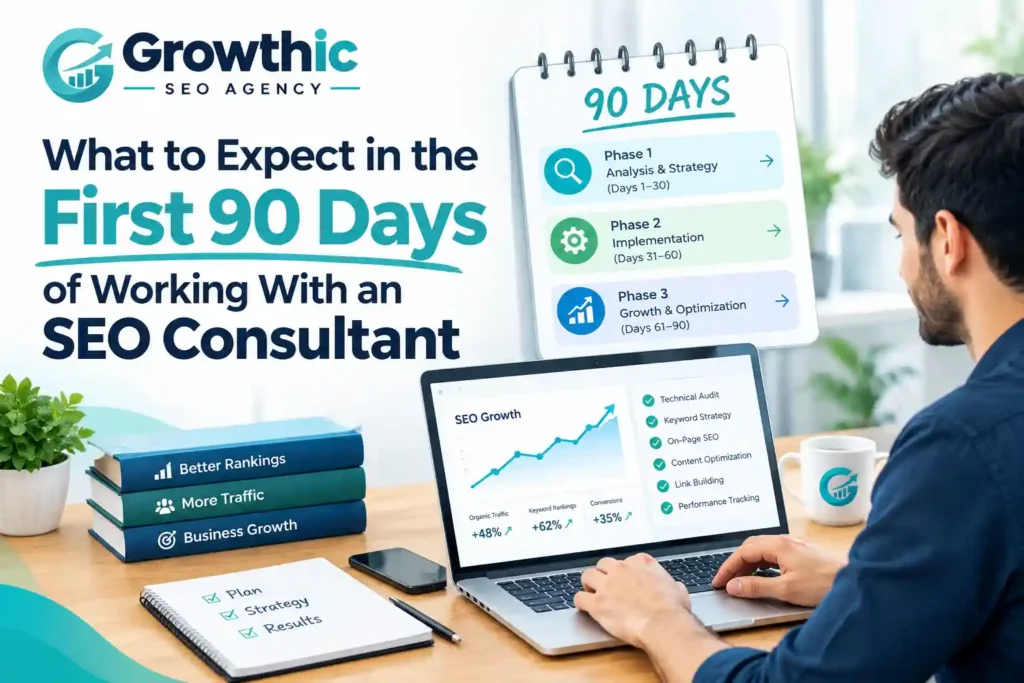
Days 1–30: Website Audit, Research, and SEO Strategy
The first month is primarily about understanding your website and preparing a practical SEO roadmap.
A professional consultant should not start by changing every page or publishing large amounts of content without first reviewing your current situation.
1. Understanding Your Business Goals
Your consultant should begin by discussing your products or services, ideal customers, target locations, and business objectives.
For example, a local service provider may want more enquiries from a specific city, while an e-commerce business may prioritize product sales and category-page visibility.
This discussion helps determine which keywords, landing pages, and conversion actions matter most.
2. Conducting a Website SEO Audit
An SEO audit helps identify issues that may prevent search engines from discovering, understanding, or indexing important pages.
Depending on your website, the audit may examine:
- Indexing and crawlability issues
- Broken links and redirect problems
- Duplicate or poorly optimized pages
- Page titles, meta descriptions, and headings
- Internal linking and website structure
- Mobile usability and page performance
- XML sitemap and robots.txt configuration
- Canonical tags and structured data where relevant
Not every website will have all these problems. The purpose of the audit is to identify actual issues, prioritize them, and recommend appropriate fixes.
3. Keyword Research and Competitor Analysis
Your consultant should identify the search terms your potential customers use and understand the intent behind them.
For instance, someone searching for “what is technical SEO” may be looking for information, while someone searching for “SEO services for small businesses” may be comparing service providers.
Competitor analysis can reveal content gaps, useful keyword opportunities, differences in website structure, and areas where your business could provide better information.
4. Setting Up Performance Tracking
Before measuring improvement, your consultant should review available data from Google Search Console and Google Analytics 4, where applicable.
The aim is to establish a reliable starting point for measuring organic clicks, impressions, landing-page performance, and relevant enquiries or sales.
If conversion tracking is missing or inaccurate, it should be addressed as part of the initial work where the project scope allows.
What should you receive by day 30?
By the end of the first month, you should generally expect:
- An SEO audit or prioritized findings report
- Initial keyword research and competitor insights
- A record of baseline performance
- A list of recommended technical and on-page improvements
- An initial SEO roadmap with clear priorities
What not to expect: A guaranteed first-page ranking or a dramatic increase in traffic simply because an audit has been completed.
Days 31–60: Implementing Improvements and Optimizing Key Pages
The second month should move the project from research into implementation.
An audit is valuable, but its recommendations only make a difference when important changes are carried out and checked.
1. Fixing High-Priority Technical SEO Issues
Your consultant should prioritize problems based on their likely impact, urgency, and implementation effort.
For example, resolving an indexing issue affecting important service pages may be more urgent than adjusting a minor heading on a low-priority blog post.
Depending on the audit findings, work may include correcting redirects, improving internal links, addressing duplicate URLs, updating sitemap settings, or coordinating website performance improvements.
Some changes may require assistance from your developer or website administrator. Agreeing on responsibilities early helps prevent unnecessary delays.
2. Improving On-Page SEO
Your consultant may begin optimizing important service pages, product pages, category pages, or existing blog posts.
This work can include improving page titles, meta descriptions, headings, content relevance, internal links, and calls to action.
The goal is to make each page more useful to visitors while helping search engines understand its purpose.
Good on-page SEO does not mean repeating the same keyword throughout every paragraph. Content should answer the user’s question naturally and provide information that genuinely helps them make a decision.
3. Developing a Content Plan
Your SEO consultant should identify which new content or existing-page updates could support your business goals.
A content plan may include informational blog posts, service-page improvements, frequently asked questions, comparison guides, or location-specific pages where they genuinely serve users.
For example, a business offering digital marketing services might create educational content about SEO pricing, website audits, and choosing an SEO provider.
The plan should consider search intent, business relevance, available resources, and the quality of the content—not just the number of articles published.
4. Reviewing Early Performance Signals
During the second month, your consultant can compare new data with the baseline established earlier.
Useful indicators include changes in search impressions, organic clicks, indexing status, and the performance of optimized pages.
Some pages may begin showing improvements, while others may need more time. Search engines do not necessarily reflect every website change immediately.
What should you receive by day 60?
Depending on the agreed scope, you should be able to review:
- Evidence of completed technical fixes or a clear implementation status
- Updated priority pages
- A content calendar or approved content briefs
- Internal linking improvements where appropriate
- An initial performance review
- A list of remaining tasks and implementation blockers
What not to expect: Every target keyword ranking on the first page or all technical and content recommendations being completed if implementation depends on other teams.
Days 61–90: Measuring Progress and Refining the Strategy
The third month should focus on continuing implementation, evaluating early signals, and deciding what to prioritize next.
By this stage, you should have a clearer understanding of the work completed, the issues resolved, and the opportunities that remain.
1. Publishing and Improving Content
Your consultant may continue publishing approved content, updating existing pages, and strengthening connections between related topics through internal links.
New content should be relevant to your audience and provide useful information rather than existing solely to target additional keywords.
If your website has important content gaps, the consultant should explain which topics are worth addressing first and why.
2. Reviewing Keyword and Organic Search Performance
Your consultant should assess how important pages and search queries are performing compared with the original baseline.
Google Search Console can help you review impressions, clicks, click-through rates, and average positions. Google Analytics 4 can provide additional information about organic visits and tracked business actions.
When reviewing results, consider the context. Search demand, seasonality, algorithm changes, competition, and website updates can all influence performance.
A small increase in impressions may indicate that a page is appearing for more searches, but it does not automatically mean that the campaign is generating more customers.
3. Checking Whether SEO Changes Are Working
The consultant should verify that important recommendations have been implemented correctly and that the affected pages can be crawled and indexed where appropriate.
For example, if a service page was optimized, the next step is to monitor its search performance over time rather than assuming the changes have already improved rankings.
If results are weaker than expected, the consultant should investigate possible reasons and recommend adjustments based on the available evidence.
4. Preparing the Next 90-Day Roadmap
At the end of the initial engagement period, your consultant should explain what has been accomplished, what the data indicates, and which activities deserve attention next.
The next roadmap may focus on expanding useful content, addressing remaining technical issues, improving conversion paths, strengthening local visibility, or targeting additional relevant keywords.
The priorities should reflect actual findings rather than simply repeating the previous month’s task list.
What should you receive by day 90?
You should generally expect:
- A review of completed SEO work
- A comparison with baseline performance
- An explanation of positive and negative changes
- A list of outstanding issues
- Recommendations for the next quarter
- Clear priorities and responsibilities for continued work
The exact deliverables will depend on your agreement, but the consultant should be able to explain what has been done and what happens next.
How Do You Measure SEO Progress During the First 90 Days?
Rankings are only one part of SEO performance. A useful review combines search visibility, website activity, and business outcomes.
| Metric | What it tells you |
|---|---|
| Search impressions | How often your pages appear in Google search results |
| Organic clicks | How many clicks your website receives from organic Google results |
| Keyword performance | How selected queries and landing pages are performing |
| Indexed pages | Whether important pages are eligible to appear in search results |
| Organic conversions | Whether organic visitors complete tracked actions, such as enquiries or purchases |
| Technical issue status | Whether identified problems have been fixed and verified |
Not every metric needs to improve immediately. Your consultant should explain which indicators matter most for your website and how they relate to your business objectives.
For example, a local business may care more about qualified enquiries than an increase in traffic from unrelated searches.
What Are the Warning Signs During the First 90 Days?
While SEO takes time, you should still expect clear communication and evidence of work.
Watch out for these warning signs:
Guaranteed rankings: No SEO consultant can guarantee a specific Google ranking or a fixed timeline for achieving it.
No initial audit or strategy: Starting extensive work without understanding the website may lead to wasted effort.
Unclear reporting: Reports should explain what was done, what changed, and what happens next—not simply present screenshots or a long list of keywords.
Unexplained backlinks: Ask how link acquisition is handled and whether the approach follows search engine spam policies. Large backlink counts alone do not demonstrate quality.
No implementation progress: If recommendations remain outstanding, your consultant should explain the blockers, who is responsible, and the next steps.
Unrealistic traffic promises: Be cautious of claims that your traffic or leads will increase by a fixed percentage within 90 days without a proper assessment.
A good consultant sets realistic expectations, communicates openly, and adjusts the strategy based on evidence.
What Is Your Role When Working With an SEO Consultant?
SEO is a collaborative process. Your consultant may handle research, strategy, optimization, and reporting, but your business may need to provide information and approve changes.
To keep the project moving:
- Provide the required website and analytics access securely.
- Explain your services, target customers, and most profitable offerings.
- Review content and recommendations promptly.
- Arrange developer support when technical changes require it.
- Share information about enquiries, leads, and sales when relevant.
- Attend periodic review meetings and agree on priorities.
Delays in approvals or implementation can slow progress, even when the SEO strategy is appropriate.
Frequently Asked Questions
Can SEO show results within 90 days?
Some websites may see early improvements in indexing, impressions, or rankings within 90 days. Others take longer, depending on competition, website condition, content quality, and implementation speed. The first three months should establish a foundation and provide useful performance data, not a guaranteed result.
What should an SEO consultant do in the first month?
The first month usually includes business discovery, website auditing, keyword research, competitor analysis, baseline measurement, and roadmap development. Depending on the website and project scope, urgent fixes may also begin during this period.
How often should an SEO consultant provide reports?
Many businesses use monthly performance reports supported by shorter weekly or fortnightly updates when needed. The reporting schedule should be agreed upon at the start and should cover completed work, key metrics, outstanding tasks, and upcoming priorities.
Should I continue SEO after the first 90 days?
If organic search is an important acquisition channel for your business, SEO often requires ongoing work. After the first 90 days, use the results and findings to decide which activities to continue, change, or stop. The decision should be based on your goals, budget, and evidence of progress.
Is it a red flag if my rankings have not improved after three months?
Not necessarily. SEO performance depends on several factors, and some changes take longer to influence search visibility. However, your consultant should be able to demonstrate completed work, explain the current data, investigate barriers, and provide a credible next-step plan.
Final Thoughts
The first 90 days of working with an SEO consultant should give your business clarity, direction, and a practical foundation for long-term organic growth.
In the first month, expect research, audits, and planning. In the second month, look for priority improvements and implementation. In the third month, expect a meaningful review of completed work, early performance signals where available, and a roadmap for the next phase.
Remember that SEO success is not measured by rankings alone. The ultimate goal is to make your website more visible to relevant audiences and help turn that visibility into valuable business outcomes.
Choose an SEO consultant who communicates clearly, explains their decisions, measures progress honestly, and focuses on work that supports your goals.
If you are planning to improve your website’s organic visibility, explore Growthic’s SEO services to learn how a structured SEO strategy can support your business growth.