Getting your website on the first page of Google India can help your business reach more potential customers, increase brand visibility, and generate organic enquiries without paying for every click. However, ranking on page one requires more than adding keywords to your website or publishing a few blog posts.
Your website needs to match what people are searching for, provide useful information, work properly on mobile devices, and demonstrate why its pages deserve to appear in search results.
Whether you run a local business, an e-commerce store, a startup, or a service-based company, the right SEO strategy begins with understanding your audience and the competition.
In this guide, you will learn how to rank on the first page of Google India through practical SEO techniques, how to prioritize your efforts, and how to measure progress.
Can You Rank on the First Page of Google India?
Yes, websites can earn first-page rankings by improving their relevance, quality, technical accessibility, and overall usefulness. However, no SEO consultant can guarantee a specific ranking or exact timeline.
Your chances depend on several factors, including:
- How competitive your target keywords are
- Your website’s age, history, and current visibility
- The quality and relevance of your content
- Technical SEO issues and indexing
- The strength of competing websites
- Your business location and target audience
- How consistently you implement improvements
For example, ranking for a specific local service in a smaller city may involve a different level of competition than ranking for a broad national keyword such as “digital marketing services.”
The best approach is to identify realistic opportunities, improve the pages that matter most, and track results over time.
1. Find the Right Keywords for the Indian Market
Keyword research is the foundation of an effective SEO strategy. It helps you understand what your potential customers search for and what type of content they expect to find.
Instead of targeting only broad, high-volume keywords, look for terms that are relevant to your business and reflect a clear user need.
Target different types of keywords
Broad keywords: These describe a general topic, such as “SEO services.”
Long-tail keywords: These are more specific searches, such as “affordable SEO services for small businesses in India.”
Local keywords: These include a city or service area, such as “SEO company in Nashik.”
Transactional keywords: These indicate that someone may be ready to contact a provider or make a purchase, such as “hire an SEO consultant in India.”
For a small business, a specific keyword with clear commercial intent may be more valuable than a broad keyword that attracts visitors who are unlikely to become customers.
Use keyword research tools
You can use Google Search Console to discover queries for which your website already receives impressions. Google Keyword Planner, Semrush, and Ahrefs can help you investigate search demand, keyword variations, and competition.
Google autocomplete and related search suggestions can also help you understand how people phrase their questions.
For every important keyword, consider:
- Search intent
- Relevance to your products or services
- Search demand in India
- Ranking competition
- Business value
- Whether your website has a suitable page
Avoid choosing keywords based only on search volume. The goal is to attract the right audience, not simply more visitors.
2. Analyze the First-Page Google Results
Before creating or optimizing a page, search for your target keyword and study the results currently appearing.
Look at the types of pages Google displays. Are they service pages, product listings, detailed guides, comparison articles, or local business profiles?
This can reveal the intent behind a search and help you decide what kind of page to create.
For example, someone searching for “SEO audit checklist” probably expects a practical guide. Someone searching for “SEO company in Nashik” may want to compare service providers and contact one.
Review competing pages for:
- Topics and questions they cover
- Content gaps you can address
- Clarity of headings and page structure
- Useful examples, data, and original insights
- Internal links and supporting resources
- Ease of navigation and mobile usability
Do not simply copy a competitor’s content or headings. Use your research to create a more useful, accurate, and distinctive page.
3. Optimize Your Page for On-Page SEO
On-page SEO helps search engines and users understand the purpose of each page.
Start with your most important service pages, product pages, category pages, or blog posts rather than trying to optimize your entire website at once.
Write a clear SEO title
Your title should accurately describe the page and make sense to a potential visitor.
For example:
SEO Company in Nashik | SEO Services for Businesses
Use your main keyword naturally when it fits the page. Avoid repeating variations of the same keyword unnecessarily.
Create a useful meta description
A meta description should briefly explain what the visitor can expect from the page.
Example:
“Looking for SEO services in Nashik? Explore practical SEO solutions to improve website visibility, attract relevant traffic, and support business growth.”
Google may generate a different search snippet depending on the query, so a well-written meta description does not guarantee that the exact text will appear.
Structure your content with headings
Use one clear main heading, followed by logical subheadings that organize the information.
For example:
- H1: SEO Services for Small Businesses in India
- H2: What SEO Services Include
- H2: How SEO Can Help Small Businesses
- H2: SEO Pricing and Deliverables
- H2: Frequently Asked Questions
Headings should make the content easier to understand. You do not need to force a keyword into every heading.
Improve internal linking
Link related pages together using descriptive anchor text.
A blog about SEO pricing could link to your SEO services page. A guide to local SEO could link to a relevant location or service page.
Internal links help visitors discover related information and help search engines understand how your pages are connected.
4. Publish Helpful, Original Content
Content remains an important part of SEO because it helps answer questions, demonstrate knowledge, and provide value to potential customers.
However, publishing more articles does not automatically improve rankings. Google recommends content created primarily to help people, rather than content produced mainly to manipulate search rankings.
Create content that solves real problems
Think about the questions your customers ask before buying a product or hiring a service.
For example, an SEO business could publish helpful guides about:
- How much SEO services cost in India
- How to choose an SEO consultant
- What to expect in the first 90 days of SEO
- How to improve local business visibility
- How to identify common website SEO issues
- How to measure organic traffic and enquiries
Each article should serve a clear purpose and provide enough detail to help readers make progress.
Demonstrate real experience
Where possible, include practical examples, screenshots, original research, real project insights, and explanations based on your professional experience.
For example, rather than writing only general advice about technical SEO, explain how a particular type of indexing issue can affect a website and how to investigate it.
Publish accurate information, identify authors where appropriate, and keep important content updated when something material changes.
Avoid keyword stuffing and repetitive articles
Repeating the same phrase excessively can make content difficult to read and does not guarantee higher rankings.
Likewise, creating many near-identical pages for slightly different keywords can produce a poor experience for visitors.
Focus on useful information, natural language, and meaningful differences between pages.
5. Fix Technical SEO Problems
Even excellent content can struggle to appear in search results if search engines cannot access or understand the relevant pages.
A technical SEO review should identify issues that affect crawling, indexing, website structure, and usability.
Check the following areas:
Indexing: Use Google Search Console to check whether important pages are indexed and investigate any unexpected exclusions.
XML sitemap: Ensure your sitemap contains the canonical URLs you want search engines to discover.
Robots.txt: Confirm that important pages and resources are not accidentally blocked from crawling.
Canonical tags: Check that duplicate or similar URLs are handled appropriately.
Redirects and broken links: Resolve unnecessary redirect chains, broken internal links, and incorrect redirects.
Mobile usability: Make sure important content and functions work well on mobile devices.
HTTPS: Use a secure website connection.
Page experience: Review loading performance, responsiveness, layout stability, and usability.
Use Google’s PageSpeed Insights and Search Console to investigate relevant performance issues. Prioritize problems based on their real impact instead of making changes simply to achieve a perfect tool score.
6. Improve Your Website’s Local SEO
If your business serves customers in a particular city or region, local SEO can help you become more visible for location-based searches.
For example, a business serving Nashik may want to reach people searching for its services in Nashik rather than competing immediately for every national keyword.
Optimize your Google Business Profile
If your business is eligible for a Google Business Profile, keep the information accurate and complete.
Important details include:
- Correct business name and category
- Accurate address or service area, where applicable
- Current phone number and website
- Appropriate business hours
- Relevant services
- Genuine photographs
- Responses to customer reviews
Follow Google’s eligibility and representation guidelines. Do not create fake locations or add keywords to your business name unless they are genuinely part of the real-world business name.
Create useful location pages
If you serve multiple locations, create pages only where you can provide genuinely useful, location-specific information.
A useful page may explain the services available in that area, the customers you serve, relevant examples, and how people can contact you.
Simply replacing a city name across dozens of otherwise identical pages is unlikely to provide meaningful value.
Build a consistent business presence
Where appropriate, maintain accurate business details across reputable directories and industry platforms. Encourage genuine customer feedback and make it easy for customers to understand your services.
Local SEO should support your actual business operations, not create an artificial online presence.
7. Earn Relevant, Quality Backlinks
Backlinks are links from other websites to yours. Relevant links can help people discover your content and may contribute to your site’s authority and visibility.
However, not every backlink is useful, and buying large quantities of low-quality links can create risks.
Focus on earning links through activities such as:
- Publishing original research or useful resources
- Creating helpful industry guides
- Building genuine professional relationships
- Contributing expert insights to relevant publications
- Getting listed in legitimate industry or local directories
- Earning mentions from partners and organizations you actually work with
Review your backlink profile periodically, but do not assume that a high backlink count automatically means better rankings.
Avoid link schemes designed primarily to manipulate search results, including mass-produced links from unrelated websites.
8. Make Your Website Useful on Mobile Devices
Your website should be easy to use on the devices your customers rely on.
Check that:
- Text is readable without zooming
- Navigation is simple
- Buttons and forms work correctly
- Important content is available on mobile
- Pages load efficiently
- Pop-ups do not interfere with the main content
- Contact information is easy to find
A technically sound mobile experience supports users and helps ensure that your content is accessible to search engines.
Do not focus only on speed scores. Review how the site actually feels to use and fix problems that prevent visitors from finding information or completing important actions.
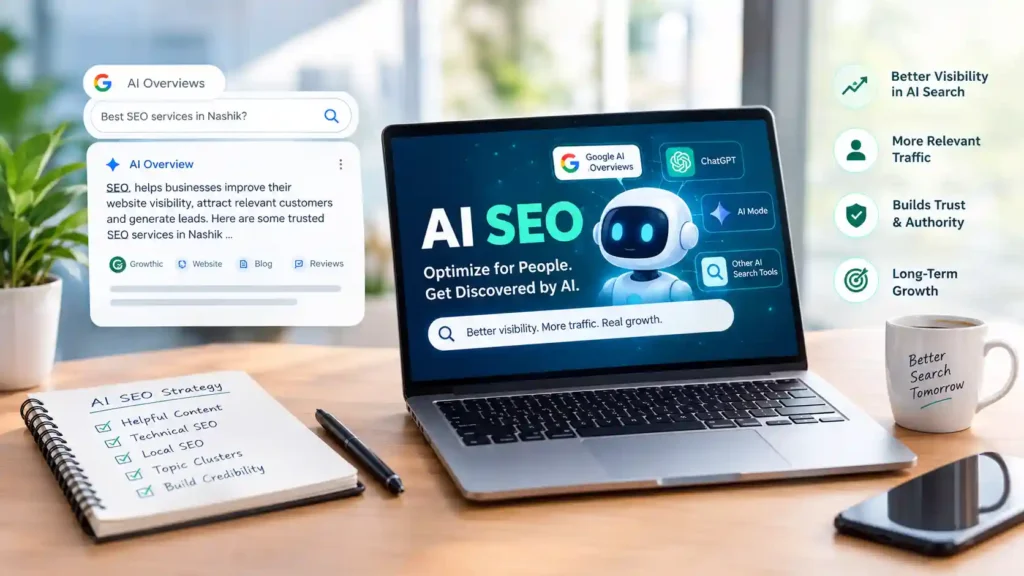
9. Optimize Content for AI Search Experiences
Google’s AI-powered search experiences make it useful to create content that answers questions clearly and demonstrates real knowledge.
There is no separate guaranteed shortcut for ranking in AI Overviews. Start with sound SEO practices and create helpful, accessible content that provides direct answers and useful context.
Consider these improvements:
- Answer the main question near the beginning of the page.
- Use descriptive headings and logical sections.
- Explain important concepts in straightforward language.
- Include examples, evidence, and original insights.
- Keep factual information accurate and current.
- Use relevant structured data when it accurately represents visible page content.
- Make important content accessible to search engines.
Do not add schema merely because you expect it to guarantee a ranking or an AI citation. Structured data can help search engines understand eligible content, but it does not guarantee special search features.
For official guidance, read Google’s documentation on AI features and your website.
10. Track Your SEO Performance Consistently
SEO requires ongoing measurement. Without tracking, it is difficult to know which pages are improving and which need further attention.
Use Google Search Console
Review:
- Total clicks and impressions
- Queries bringing visitors to your site
- Pages gaining or losing visibility
- Average position trends
- Indexing issues
- Relevant search appearance data
Compare similar date ranges and consider seasonality before drawing conclusions from short-term changes.
Use Google Analytics 4
Where correctly configured, GA4 can help you understand how organic visitors interact with your website and whether they complete important actions.
For a service business, these actions might include submitting an enquiry form or clicking a phone number. For an online store, they may include purchases or other meaningful events.
Review progress by page and business goal
Do not evaluate your campaign only by checking one keyword manually.
Track a group of relevant keywords, important landing pages, organic traffic, and conversions. Search results can vary with location, device, and other context, so Search Console data is useful for understanding broader performance trends.
A Practical 90-Day SEO Plan for Google India
Use this timeline as a starting framework. The exact work and pace will depend on your website, budget, competition, and implementation resources.
| Period | Main priorities |
|---|---|
| Days 1–30 | Audit the website, research keywords, analyze competitors, establish performance baselines, and plan improvements |
| Days 31–60 | Fix priority technical issues, optimize important pages, improve internal links, and develop useful content |
| Days 61–90 | Continue implementation, review early performance signals, improve underperforming pages, and plan the next phase |
Some websites may show early progress during this period, while others need longer. Use the first 90 days to establish a reliable process rather than expecting guaranteed first-page rankings.
Common SEO Mistakes That Can Hold Your Website Back
Avoid these common mistakes when trying to rank on Google India:
- Targeting keywords that are too competitive for your current website.
- Publishing content without understanding search intent.
- Repeating keywords unnaturally across pages.
- Ignoring indexing and technical SEO problems.
- Building irrelevant or manipulative backlinks.
- Creating duplicate location pages with little unique value.
- Measuring success only through keyword rankings.
- Making frequent website changes without tracking their impact.
- Expecting guaranteed rankings within a fixed timeframe.
- Publishing AI-generated content at scale without checking accuracy, originality, and usefulness.
A clear strategy and consistent implementation are more valuable than chasing every new SEO tactic.
Frequently Asked Questions
How long does it take to rank on the first page of Google India?
There is no fixed timeline. Less competitive searches may respond sooner, while competitive national keywords can require sustained work over a longer period. The website’s condition, content quality, competition, and implementation speed all influence progress.
Can a new website rank on Google’s first page?
Yes, a new website can rank for relevant searches, but it needs accessible pages, useful content, and a clear focus. Starting with specific, relevant keywords may provide more realistic opportunities than immediately targeting highly competitive national terms.
Is SEO free in India?
Organic listings do not charge you for each click, but SEO still requires time and resources. Costs may include strategy, content creation, technical development, tools, and professional services.
Are backlinks necessary to rank on the first page?
There is no universal backlink requirement for every keyword. Relevant backlinks may support visibility, but content quality, search intent, technical accessibility, competition, and many other signals also matter. Do not buy links simply to reach a target number.
Does publishing blogs every day improve Google rankings?
Not necessarily. Publishing frequency alone does not guarantee rankings. A smaller number of original, helpful articles that serve your audience can be more valuable than a large volume of repetitive or low-value content.
Can an SEO expert guarantee first-page rankings?
No reliable SEO expert can guarantee a specific Google position or an exact date for reaching it. A consultant can research opportunities, implement best practices, measure results, and improve the strategy based on evidence.
Final Thoughts
Ranking on the first page of Google India requires a focused approach to keyword research, useful content, technical SEO, local optimization where relevant, and consistent performance analysis.
Start by identifying the searches most relevant to your business. Build pages that genuinely answer those searches, resolve technical problems, improve your website experience, and earn relevant visibility over time.
Avoid shortcuts, keyword stuffing, and guaranteed-ranking promises. Instead, measure progress through search visibility, qualified traffic, and meaningful business outcomes.
If you want a structured approach to improving your website’s organic visibility, explore Growthic’s SEO services and identify the SEO priorities that best fit your business goals.